
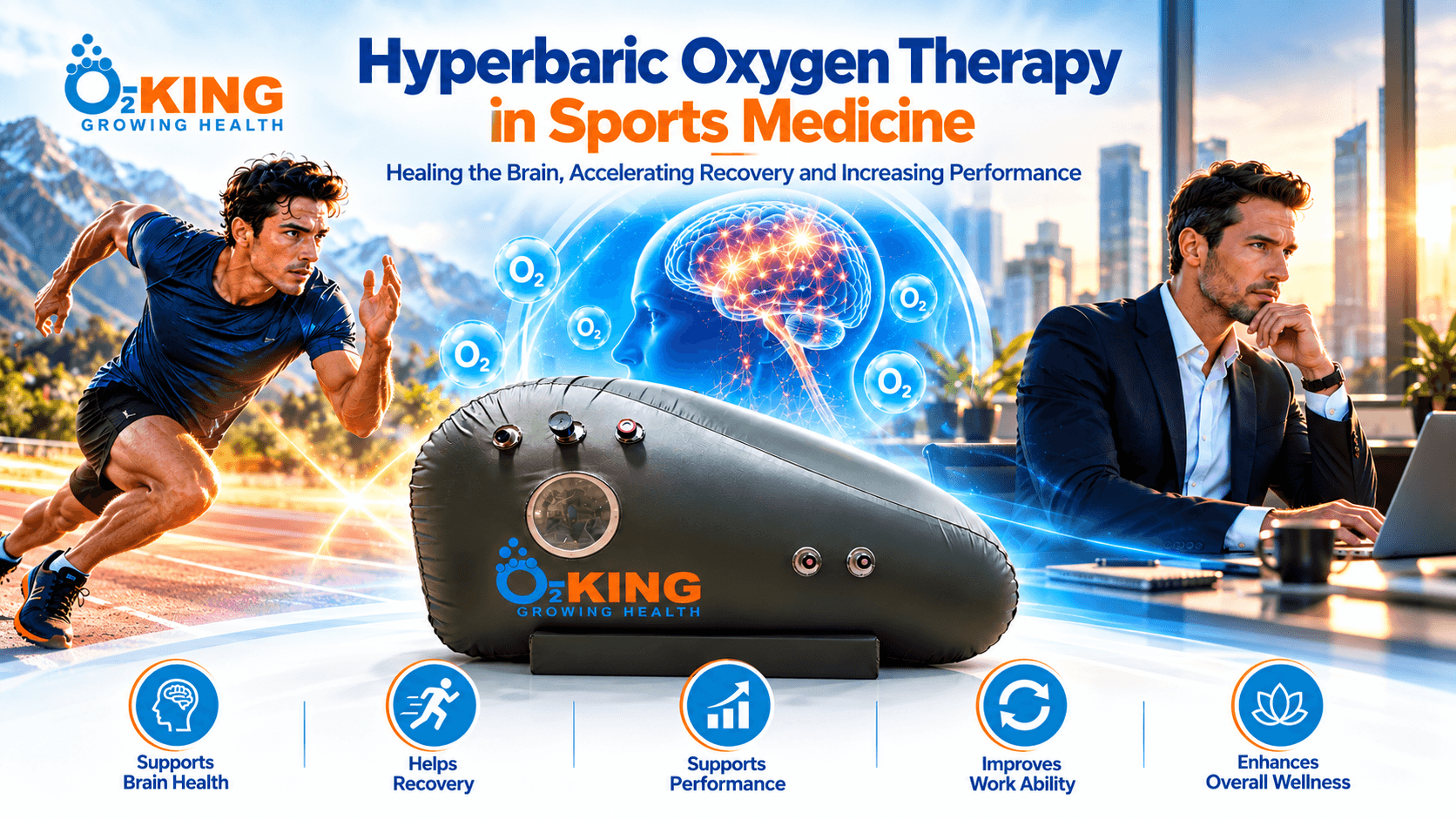
Hyperbaric Oxygen Therapy in Sports Medicine: Healing the Brain, Supporting Recovery and Performance
Hyperbaric Oxygen Therapy (HBOT) in sports medicine is becoming an increasingly interesting subject for athletes, coaches, sports organizations, recovery centers, wellness businesses, and performance-focused entrepreneurs. As modern sport becomes more competitive, the conversation is no longer limited to how hard an athlete can train. Increasingly, attention is also being given to what happens between training sessions—recovery, rest, preparation, nutrition, sleep, and the technologies that can become part of a structured performance routine.
This shift has also created interest in HBOT oxygen therapy chambers. Once primarily associated with specialized environments, hyperbaric chambers are now being explored in sports recovery facilities, wellness centers, longevity centers, private settings, and biohacking environments. At the same time, entrepreneurs are looking at HBOT not only as a technology for personal wellness but also as a potential addition to a modern recovery or longevity business.
However, HBOT is best understood as one component of a broader wellness and performance environment, rather than a replacement for proper training, nutrition, sleep, professional healthcare, or other established approaches. The technology is interesting precisely because it can be incorporated into a wider strategy instead of being treated as a magic solution.
What Is Hyperbaric Oxygen Therapy?

Hyperbaric Oxygen Therapy is a technology-based session performed inside a specially designed hyperbaric oxygen therapy chamber. The chamber creates a pressurized environment, and oxygen is delivered according to the configuration and operating protocol of the system.
There are many types of hyperbaric chambers available today. Portable and soft-shell systems can offer a different experience from larger hard-shell chambers, while professional facilities may consider larger or specialized configurations depending on their intended use. Chamber design, operating pressure, oxygen-delivery systems, monitoring, capacity, comfort, installation requirements, maintenance, and staff training can all influence which system is appropriate.
This is why choosing an HBOT chamber should involve more than simply comparing one pressure specification with another. A serious buyer should first understand the intended users, facility, operating model, available space, expected usage, and long-term business objectives.
Why Is HBOT Attracting Attention in Sports Medicine?
Modern sports performance is built around details. At the elite level, athletes and teams may spend enormous amounts of time and money looking for ways to improve training, preparation, recovery, and consistency.
The traditional view of athletic performance was relatively simple: train harder, become stronger, become faster, and compete better. Today, the picture is much broader. Professional sports environments can include strength and conditioning programs, physiotherapy, nutrition, sleep monitoring, mobility work, compression technologies, cold-water recovery, wearable technology, psychological support, and specialized recovery facilities.
HBOT has entered this wider conversation as another technology that athletes and sports organizations may choose to investigate.
The important point is that HBOT does not need to replace other recovery strategies to have a place in a sports environment. It can instead be considered as one component within a structured approach to athlete wellness and recovery.
Recovery Is Becoming Part of Athletic Performance
An athlete’s training session is only one part of the performance cycle. What happens after training can be equally important to maintaining a consistent routine.
Consider a professional cyclist preparing for an important competition. Their schedule might include intensive training sessions, carefully planned meals, hydration, sleep, stretching, mobility work, physiotherapy, travel preparation, and designated recovery periods. The objective is not simply to train as much as possible. It is to create a sustainable system around the athlete.
This is where recovery technology becomes interesting.
An HBOT chamber for athletes can potentially become part of a dedicated recovery environment where different services are brought together. Rather than presenting one technology as the answer to everything, sports facilities can create a more comprehensive experience around the athlete.
For sports clubs, academies, cycling organizations, football facilities, and performance centers, this approach can also create opportunities to develop additional services for members and athletes.
The Brain Is an Important Part of Sports Performance

When people think about athletic performance, they often focus on muscles, strength, endurance, speed, and physical conditioning. But competitive sport is also a mental activity.
Athletes have to concentrate, make decisions quickly, follow tactics, react to changing situations, communicate with teammates, and maintain focus under pressure. In many sports, the difference between a good performance and an exceptional one can involve decision-making and mental preparation as much as physical ability.
This is why brain health and mental performance have become increasingly important topics within modern sports science and athlete wellness.
HBOT is sometimes discussed in this context, but responsible communication is essential. Rather than making broad promises about cognitive improvement or claiming that HBOT can “heal the brain,” it is more appropriate to describe it as an area of continuing research and technological interest within sports and wellness environments.
That distinction matters. A professional brand should educate its audience without turning scientific possibilities into guaranteed outcomes.
What Does HBOT Mean for Entrepreneurs?

At first, athletes and entrepreneurs may appear to have very little in common. One spends their day training and competing; the other may spend theirs in meetings, managing employees, travelling, making decisions, and building a company.
But there is a common factor: both operate under sustained performance demands.
An athlete may have training schedules, competitions, travel, and physical demands. An entrepreneur may have deadlines, business decisions, financial responsibilities, client meetings, travel, and long working hours. Both can fall into the same trap of focusing almost entirely on output while giving too little attention to recovery.
This is one reason HBOT for entrepreneurs has become part of the broader conversation around wellness and biohacking.
Entrepreneurs who are already interested in fitness technology, wearable devices, longevity, structured wellness routines, and performance optimization may see an HBOT session as another experience that can fit into their personal wellness routine.
The sensible approach, however, is not to promise that a chamber session will automatically make someone more productive or successful. Instead, HBOT can be considered within a larger lifestyle framework that includes sleep, exercise, nutrition, stress management, and healthy routines.
From Personal Wellness to Longevity Centers
The growing interest in longevity has created a new category of businesses designed around long-term wellness and performance. Modern longevity centers increasingly combine different services and technologies rather than relying on a single treatment or piece of equipment.
An HBOT chamber can fit naturally into this type of environment.
A longevity center may combine hyperbaric oxygen technology with fitness, nutritional guidance, recovery services, health assessments, lifestyle programs, and other wellness technologies. Similarly, a biohacking facility may use an HBOT chamber as one part of a larger technology-focused experience.
The business opportunity therefore extends beyond professional sport.
Potential environments include:
- Sports performance centers
- Athlete recovery facilities
- Wellness and recovery studios
- Longevity centers
- Biohacking centers
- Premium fitness facilities
- Physiotherapy and rehabilitation environments
- Luxury wellness destinations
- Corporate wellness facilities
- Private residential installations
The key is understanding the audience and designing the chamber experience around the wider purpose of the facility.
Building a Biohacking Hyperbaric Setup
A biohacking hyperbaric setup should begin with a business strategy rather than with a product catalogue.
Before purchasing an HBOT oxygen therapy chamber, a facility owner should consider several practical questions. Who will use the chamber? How many sessions are expected each week? What type of facility is being created? How much space is available? What other services will surround the chamber? Will customers pay per session, purchase memberships, or access HBOT as part of a larger wellness package?
The physical chamber is only one part of the setup.
A professional facility also needs to consider room design, workflow, staff training, equipment maintenance, customer experience, operational procedures, and long-term technical support. These factors can have a major influence on the success of a commercial HBOT business.
For entrepreneurs entering the longevity or wellness industry, this is an important distinction: buying a chamber and building a successful HBOT business are two different things.
What Should You Consider When Choosing an HBOT Chamber?
The market offers many different types of hyperbaric oxygen chambers, so buyers should look beyond marketing headlines.
Chamber construction
Consider the materials, construction quality, access, visibility, interior configuration, and overall user experience.
Operating specifications
Understand the chamber’s operating capabilities and ensure they match the intended application and facility requirements.
Oxygen delivery
Look carefully at how oxygen is supplied and integrated into the system.
Controls and monitoring
Professional environments should consider appropriate monitoring, controls, alarms, and operational procedures.
Maintenance and technical support
A chamber is a long-term investment. Maintenance, replacement components, technical support, and staff training should be considered before making a purchasing decision.
Capacity and facility requirements
A private user, a boutique recovery center, and a large sports organization may all need completely different chamber configurations.
Purchase flexibility
For businesses, the ability to buy, rent, or lease equipment can make it easier to choose an investment model that fits available capital and expected usage.
O2-KING HBOT Chambers for Longevity Centers and Biohacking Setups

For businesses looking for an HBOT oxygen therapy chamber for a longevity center, sports recovery facility, wellness business, or biohacking hyperbaric setup, O2-KING offers a range of chamber solutions designed for different environments and applications.
O2-KING’s approach goes beyond simply supplying a chamber. The company provides options for BUY, RENT, and LEASE, allowing customers to select an acquisition model according to their project and investment strategy. For a new longevity center or wellness business, this flexibility can be particularly useful when evaluating the commercial potential of an HBOT service.
O2-KING also states that it is IBUM and IHA certified and a member of these organizations, reinforcing its positioning within the professional hyperbaric industry. For entrepreneurs developing a new HBOT facility, the goal should not simply be to place a chamber inside a room. The goal should be to create a professional, well-designed environment where the chamber becomes part of a complete customer experience.
With different chamber configurations available, O2-KING can be considered by private users, sports organizations, wellness operators, longevity centers, recovery facilities, and entrepreneurs developing a biohacking hyperbaric setup.
BUY, RENT OR LEASE: Choosing the Right Model
Not every customer wants to make the same type of investment.
For an established wellness center or sports facility with predictable demand, purchasing an HBOT chamber may make sense as a long-term equipment investment. A business that wants to introduce HBOT while keeping initial capital requirements more controlled may prefer a rental model.
Leasing can provide another route for businesses that want to incorporate professional equipment into their operation without making the entire investment upfront.
There is no universally correct choice. The appropriate model depends on the facility, expected utilization, available capital, customer demand, and long-term business strategy.
For this reason, O2-KING offers BUY • RENT • LEASE options for customers interested in incorporating HBOT into their personal or professional environment.
The Opportunity for Sports Clubs and Athletes
For sports organizations, the value of an HBOT chamber may extend beyond the chamber itself.
A football academy, for example, could develop a dedicated recovery area. A cycling club could create a performance and recovery environment. A professional sports organization could incorporate HBOT alongside its existing athlete-support infrastructure.
This creates an opportunity to think about the chamber as part of a complete service rather than an isolated product.
The strongest sports recovery environments are often built around several complementary elements: training, nutrition, mobility, recovery, education, monitoring, and athlete support. An HBOT chamber can be considered within that larger ecosystem.
For athletes, the broader message is simple:
Performance is not only about how hard you train. It is also about how intelligently you structure everything around your training.
The Opportunity for Entrepreneurs
For entrepreneurs, the opportunity is slightly different.
The growing interest in longevity, biohacking, recovery, wellness technology, and human performance is creating new categories of businesses. Customers are increasingly familiar with wearable technology, fitness tracking, recovery tools, personalized wellness programs, and technology-focused experiences.
That creates room for entrepreneurs who can combine technology with a strong customer experience.
But a successful HBOT business should not rely solely on the novelty of the chamber. A customer may be attracted by the technology once, but a professional environment, good service, education, comfort, reliability, and a coherent wellness program are what can encourage long-term engagement.
In other words, the chamber may attract attention, but the experience builds the business.
Moving Beyond HBOT Hype
The hyperbaric oxygen industry operates in an area where technology, science, wellness, and marketing often overlap. That creates a temptation to make increasingly dramatic promises.
A more responsible approach is also a more sustainable one.
Instead of saying that HBOT can solve every problem, brands can explain what the technology is, how a chamber works, where it is being explored, what the intended experience is, and how it can fit into a broader wellness or sports-performance environment.
This style of communication is particularly important for companies targeting professional athletes, entrepreneurs, longevity centers, and sophisticated consumers.
People are becoming more informed.
They do not simply want marketing claims. They want to understand the technology.
That is an opportunity for brands such as O2-KING to position themselves through education, transparency, equipment quality, and customer support rather than relying solely on sensational advertising.
The Future of Sports Recovery and Performance
The world of sports performance is changing rapidly.
Athletes now have access to technologies that previous generations could hardly imagine. Wearable devices can track training and sleep. Recovery facilities can provide multiple technologies under one roof. Sports organizations increasingly treat athlete wellness as a complete system rather than a collection of isolated services.
Entrepreneurs are following the same trend.
Longevity centers, recovery studios, wellness facilities, and biohacking businesses are creating environments where people can explore different technologies as part of a broader approach to personal performance and wellness.
HBOT is part of this evolving landscape.
Its role should be approached thoughtfully, without exaggerated promises. The chamber is a piece of technology; its real-world value depends on how it is selected, operated, integrated, and experienced.
That is perhaps the most important lesson for both athletes and entrepreneurs.
Technology works best when it becomes part of a well-designed system.
Conclusion: Recovery Is Becoming a Performance Strategy
The conversation around Hyperbaric Oxygen Therapy in Sports Medicine reflects a much larger change in the way people think about performance.
Athletes are looking beyond training alone. Entrepreneurs are looking beyond productivity alone. Longevity centers are looking beyond traditional wellness models. And consumers are becoming increasingly interested in technologies that can become part of structured recovery and wellness routines.
HBOT does not need to be presented as a miracle to be interesting.
Its value lies in the technology itself and in the possibilities it creates when integrated thoughtfully into sports, wellness, longevity, and performance environments.
For athletes, it can become part of a broader recovery-focused environment. For entrepreneurs, it can become part of a modern wellness strategy. For businesses, it can become one component of a new-generation longevity or biohacking facility.
And for organizations considering an HBOT oxygen therapy chamber, choosing the right equipment, support structure, acquisition model, and facility concept is just as important as the chamber itself.
Explore O2-KING HBOT Oxygen Chambers
O2-KING — Growing Health
O2-KING provides HBOT oxygen chamber solutions for private users, athletes, sports organizations, wellness businesses, longevity centers, recovery facilities, and biohacking environments.
BUY • RENT • LEASE
📲 WhatsApp: +31 623 811 827
🌐 Website: www.O2KING.com
