
Introduction: Is More Oxygen Always Better?
Imagine comparing two hyperbaric oxygen therapy chambers. One advertises an oxygen concentration of 93%, while another highlights a pressure rating of 2.0 ATA. Which chamber delivers more oxygen? Which is better suited to a wellness centre, sports recovery facility, or longevity-focused business?
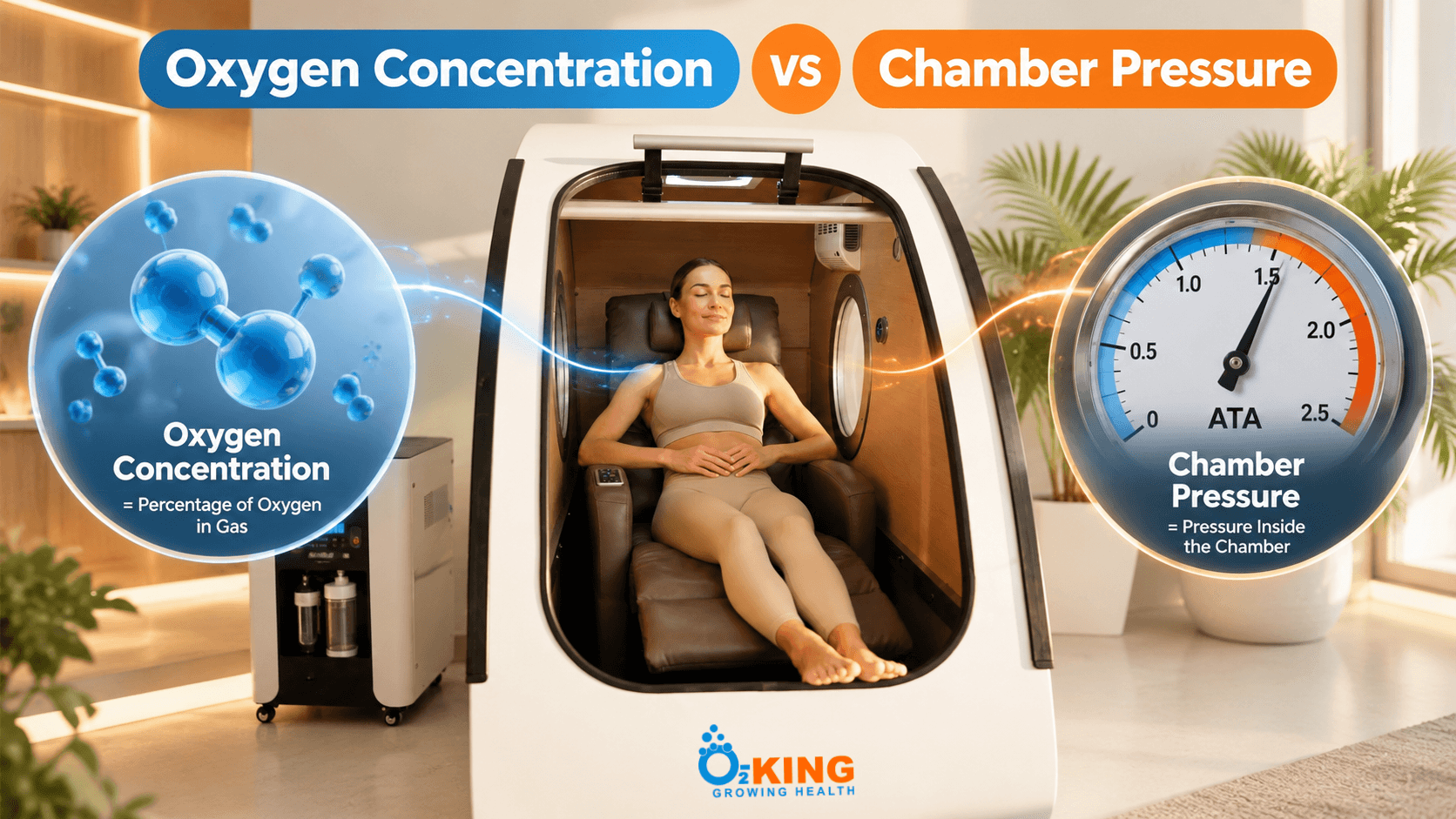
The answer is not as straightforward as it might seem. Oxygen concentration and chamber pressure are two different measurements, and neither tells the whole story on its own. Oxygen concentration describes the proportion of oxygen in a gas mixture, while chamber pressure describes the pressure inside the chamber relative to the surrounding atmosphere. Together, under the right conditions, these factors influence the partial pressure of oxygen available for breathing.
Understanding this distinction helps consumers, healthcare professionals, wellness-centre operators, and biohacking enthusiasts make better-informed decisions when evaluating hyperbaric oxygen therapy (HBOT) equipment. Let’s explore the science behind these measurements, examine practical examples, and explain what to look for when comparing oxygen therapy chambers.
1. What Is Oxygen Concentration?

Oxygen concentration refers to the percentage of oxygen in a gas mixture. Under normal conditions at sea level, the air we breathe contains approximately 21% oxygen, with most of the remaining gas consisting of nitrogen.
An oxygen concentrator separates oxygen from ambient air and supplies a gas with a higher oxygen concentration. Depending on the device and operating conditions, some oxygen concentrators produce output around 90–96% oxygen. The exact purity depends on the equipment, flow rate, maintenance, and operating specifications.
Why Does Oxygen Concentration Matter in HBOT?
In hyperbaric oxygen therapy, the oxygen concentration of the gas a person breathes is an important part of the treatment setup. For example, a person may breathe oxygen through a dedicated mask or breathing circuit while inside a pressurised chamber. In other configurations, the oxygen content of the chamber atmosphere itself is relevant. These arrangements are not identical.
A chamber’s oxygen concentrator might supply a high-purity oxygen stream to a breathing circuit without making the entire chamber atmosphere equally oxygen-rich. Therefore, it is essential to understand what a product specification actually measures.
When reviewing an HBOT oxygen chamber, distinguish between:
- Oxygen concentrator output purity: The percentage of oxygen in the gas produced by the concentrator.
- Inspired oxygen concentration (FiO₂): The fraction of oxygen in the gas a person actually inhales.
- Chamber atmosphere: The gas mixture present inside the pressurised chamber.
These measurements are related, but they should not automatically be treated as interchangeable. For medical applications, oxygen purity must also meet the applicable requirements for the intended use. A machine’s advertised oxygen percentage alone does not establish that its gas supply or treatment protocol is suitable for medical HBOT.
2. What Is Chamber Pressure?

Chamber pressure describes the pressure maintained inside a hyperbaric chamber. It is commonly expressed in atmospheres absolute, abbreviated as ATA. At approximately sea-level atmospheric pressure, 1 ATA represents normal atmospheric pressure.
When a hyperbaric chamber is pressurised above this level, the gas inside exerts greater pressure than ordinary atmospheric air. For example:
- 1.0 ATA: Approximately normal atmospheric pressure.
- 1.3 ATA: Approximately 30% above normal atmospheric pressure.
- 1.5 ATA: Approximately 50% above normal atmospheric pressure.
- 2.0 ATA: Approximately twice normal atmospheric pressure.
- 2.5 ATA: Approximately 2.5 times normal atmospheric pressure.
These figures describe pressure, not oxygen concentration. A chamber operating at 2.0 ATA does not necessarily contain 100% oxygen. Its oxygen concentration depends on its gas supply and configuration.
What Does Increased Pressure Do?
When a person breathes a gas at increased pressure, the partial pressure of oxygen can rise even when the oxygen percentage remains unchanged. This is a fundamental principle of respiratory physiology and hyperbaric physics.
The increase in oxygen partial pressure can influence oxygen transfer from the lungs into the bloodstream. Under appropriate conditions, greater oxygen partial pressure also increases the amount of oxygen that can dissolve directly into the liquid component of blood, known as plasma. However, the effects depend on the complete system, including the breathing gas, pressure, duration, treatment protocol, and individual physiology.
For a deeper scientific explanation, see the National Library of Medicine’s overview of Hyperbaric Physics.
3. The Science Connecting Oxygen Concentration and Pressure
To understand why these two factors matter together, it helps to introduce a basic concept: oxygen partial pressure. Partial pressure is the portion of the total gas pressure contributed by a particular gas. According to Dalton’s law, the pressure exerted by a mixture of gases is the sum of the partial pressures of its individual gases.
For a simplified comparison, oxygen partial pressure can be estimated using this relationship:
Oxygen partial pressure ≈ Absolute pressure × Fraction of oxygen
The oxygen fraction is expressed as a decimal rather than a percentage. For instance, 93% oxygen is written as 0.93. This calculation illustrates why oxygen concentration and chamber pressure should be considered together.
Example: Comparing Different Pressure and Oxygen Combinations
The following examples assume the stated oxygen fraction is the fraction of the gas being breathed and that it is at the stated absolute pressure.
| Absolute pressure | Oxygen concentration | Approximate oxygen partial pressure |
|---|---|---|
| 1.0 ATA | 21% | 0.21 ATA |
| 1.5 ATA | 93% | 1.395 ATA |
| 1.5 ATA | 100% | 1.50 ATA |
| 2.0 ATA | 93% | 1.86 ATA |
| 2.0 ATA | 100% | 2.00 ATA |
These figures are simplified examples of gas partial pressure, not measurements of oxygen levels in the bloodstream or a complete calculation of a clinical treatment dose. They also assume that the stated concentration applies to the inhaled gas at the chamber pressure. If a chamber uses a different internal atmosphere and supplies oxygen through a mask, its actual configuration must be considered separately.
Nevertheless, the principle is clear: oxygen concentration and pressure work together to determine the partial pressure of oxygen in the breathing gas. That is why looking at just one number can lead to an incomplete comparison.
4. Why Oxygen Partial Pressure Matters to the Human Body

The lungs transfer oxygen from inhaled gas into the bloodstream. From there, oxygen is transported to tissues through circulation. Most oxygen carried in the blood is bound to haemoglobin inside red blood cells, while a smaller amount is dissolved directly in plasma.
As oxygen partial pressure increases, more oxygen can dissolve in plasma. Henry’s law describes the relationship between the partial pressure of a gas and the amount that dissolves in a liquid when other relevant conditions are held constant. This principle helps explain the physiology behind hyperbaric oxygen therapy.
However, there is an important distinction between increased oxygen availability and a guaranteed health outcome. Haemoglobin is already close to fully saturated under normal healthy conditions at sea level. Consequently, increasing inspired oxygen does not simply translate into an equivalent increase in haemoglobin-bound oxygen. The contribution of dissolved oxygen becomes particularly relevant under hyperbaric conditions.
The actual physiological response depends on many factors, including lung function, circulation, treatment pressure, inspired oxygen concentration, and exposure duration. HBOT should therefore be understood as a controlled exposure involving oxygen and pressure, rather than simply a method of supplying more oxygen.
5. Does Higher Oxygen Concentration Always Mean Better HBOT?
No. A higher oxygen percentage is not automatically an indication of a better or more suitable chamber. Consider a chamber that advertises oxygen concentrator output at approximately 93% purity. Another manufacturer advertises a higher chamber pressure. Those specifications answer different questions.
The oxygen percentage tells you about the gas composition at the point being measured. The pressure rating indicates the pressure capability or operating level, depending on the specification. Neither figure independently establishes the appropriateness, safety, or clinical effectiveness of a treatment.
Several additional considerations matter:
- Identify the actual breathing gas. A 93% oxygen concentrator output is not necessarily the same as the inspired oxygen fraction after gas delivery and mixing.
- Verify the operating pressure. A maximum pressure rating does not necessarily mean that every session should be conducted at that pressure.
- Understand the intended application. Equipment designed for a general wellness environment should not automatically be regarded as equivalent to a medical HBOT system.
- Evaluate the entire system. Chamber construction, pressure controls, gas-delivery equipment, safety monitoring, maintenance, operator training, and applicable standards all contribute to safe and appropriate operation.
A useful comparison considers the complete equipment specification instead of ranking chambers by a single headline number.
6. Does Higher Chamber Pressure Always Mean Better Results?
Higher pressure is not automatically better, either. Clinical hyperbaric oxygen therapy uses controlled protocols in which pressure, oxygen delivery, session duration, and the patient’s condition are considered together. The appropriate protocol depends on the clinical indication and relevant medical guidance.
The Undersea and Hyperbaric Medical Society (UHMS) describes specific requirements for clinical HBOT, including the use of a suitable hard-sided chamber, elevated pressure, and prescribed medical-grade oxygen under qualified medical oversight. Its published definition and guidance should be consulted when evaluating medical applications.
You can read the society’s scientific definition of hyperbaric oxygen therapy and safe-delivery guidance.
Chambers marketed for mild-pressure wellness applications, including certain devices operating around 1.2–1.5 ATA, should not automatically be assumed to provide the same treatment as clinical HBOT delivered under medical protocols. Pressure should be selected for the intended use, not simply because a higher number appears more impressive.
More pressure also brings additional technical and physiological considerations. The equipment must be designed for its operating conditions, and exposure to increased pressure and oxygen requires appropriate precautions. The practical takeaway is simple: the objective is an appropriate, well-controlled protocol—not the highest possible pressure.
7. What Is the Difference Between a Mild Hyperbaric Chamber and a Clinical HBOT Chamber?
The terminology used in the marketplace can sometimes create confusion. Mild-pressure chambers and clinical hyperbaric oxygen therapy equipment may differ in construction, operating pressure, gas delivery, intended use, and regulatory status. A device advertised as a “hyperbaric oxygen chamber” does not necessarily meet the requirements for every form of clinical HBOT.
When evaluating a chamber, ask the supplier for written specifications covering:
- Maximum rated pressure and recommended operating pressure.
- Whether pressure is measured in ATA absolute or another unit.
- Oxygen concentrator purity and flow rate under specified conditions.
- The gas composition actually delivered to the user.
- Whether oxygen is supplied through a mask, breathing circuit, or the chamber atmosphere.
- Chamber construction, applicable pressure-vessel standards, safety systems, and emergency procedures.
- Intended-use limitations, maintenance requirements, and operator training.
For clinics and other medical facilities, also establish whether the equipment meets the standards and regulatory requirements applicable in the country where it will be installed and used. These questions are more informative than relying on a product label that mentions only oxygen purity or pressure.
8. Oxygen Concentration vs Chamber Pressure: A Practical Comparison
Here is a straightforward way to distinguish the two measurements.
| Feature | Oxygen concentration | Chamber pressure |
|---|---|---|
| What it measures | Proportion of oxygen in a gas mixture | Pressure inside the chamber |
| Common expression | Percentage, such as 93% or 100% | ATA, such as 1.5 or 2.0 ATA |
| Main scientific relevance | Determines the oxygen fraction in the breathing gas | Influences gas partial pressure and physiological exposure |
| What it cannot tell you alone | Actual oxygen partial pressure at the operating pressure | Actual oxygen concentration in the breathing gas |
| What to verify | Measurement point, purity, flow rate, and delivery method | Absolute operating pressure, rated limits, and control system |
Neither measurement should be interpreted in isolation. To compare two chambers properly, determine the actual inspired oxygen concentration and operating pressure, then assess whether the equipment is suitable for its intended application.
9. How to Choose an HBOT Oxygen Chamber for a Wellness or Longevity Centre

For entrepreneurs planning a longevity centre, recovery studio, sports facility, or biohacking-focused business, equipment selection involves more than comparing ATA ratings. Begin by identifying the purpose of the installation. Will the chamber be used in a private setting, a commercial wellness facility, a sports organisation, or a medically supervised treatment environment? Each setting can have different requirements.
Next, consider capacity and layout. A single-person lying chamber, a sitting cabin, and a multi-person installation can create very different operational experiences. Available space, accessibility, ventilation, utilities, and planned visitor volume should all inform the decision.
Then examine the technical documentation. Ask the supplier to explain exactly how oxygen is delivered, how pressure is controlled, what the safety systems do, and which standards and approvals apply to the specific model.
Commercial factors matter, too. Installation, training, servicing, maintenance, parts availability, and ongoing operating costs can influence the long-term suitability of a system. A supplier should be able to explain these details clearly before you commit.
For a medical treatment facility, a qualified hyperbaric medical professional should determine the appropriate clinical protocol. For a wellness-focused business, the operator should establish the permitted use of the chosen equipment and communicate its limitations transparently.
10. Safety: Why Pressure and Oxygen Must Be Managed Together
Hyperbaric equipment requires careful handling because both increased pressure and oxygen-rich environments introduce safety considerations. Pressure changes can cause problems involving the ears, sinuses, and other air-containing spaces. Depending on the gas exposure, pressure, and treatment protocol, oxygen toxicity and other adverse effects may also be concerns.
High oxygen concentrations increase fire risk. The US Food and Drug Administration issued a safety communication on 25 August 2025 reminding healthcare providers and facilities to follow the manufacturer’s instructions, implement fire-prevention measures, train operators, monitor users, and maintain equipment properly. Read the FDA’s safety guidance for hyperbaric oxygen therapy devices.
Important precautions include:
- Follow the exact operating instructions for the selected device.
- Use only approved components and compatible materials.
- Maintain the chamber, oxygen-delivery equipment, and safety systems according to the manufacturer’s schedule.
- Provide appropriate operator training and supervision.
- Keep ignition sources and prohibited items out of the chamber.
- Ensure users receive suitable medical screening when required by the intended application.
People considering HBOT should consult an appropriately qualified healthcare professional to discuss whether it is suitable for them. Medical HBOT should be prescribed and supervised according to the relevant clinical standards.
Understanding oxygen concentration and chamber pressure is not just a matter of choosing equipment. It is also part of understanding how that equipment must be used responsibly.
11. Why Choose O2-KING for a Longevity Centre or Biohacking Hyperbaric Setup?
For businesses planning a longevity centre, biohacking hyperbaric setup, sports recovery facility, or premium wellness destination, O2-KING HBOT oxygen therapy chambers can be a strong choice for operators whose requirements match the available models, specifications, and support services. O2-KING offers chamber options for private and professional environments, with different configurations to suit varying space and capacity requirements. The company provides purchase, rental, and leasing options, allowing businesses to explore different approaches to acquiring equipment.
We are certified by and are members of the International Hyperbarics Association (IHA) and IBUM. When choosing a chamber for a longevity or biohacking facility, compare oxygen-delivery specifications, operating pressure, construction, applicable standards, intended use, and safety provisions before making a decision.
Interested in an HBOT chamber for your facility? Contact O2-KING to discuss available models and purchasing options.
- Buy, rent, or lease: Flexible acquisition options for your requirements.
- WhatsApp: +31 623 811 827
- Website: www.O2KING.com

12. The Bottom Line: Oxygen Concentration and Pressure Are Both Important
Oxygen concentration tells you how much oxygen is present in a gas mixture. Chamber pressure tells you the pressure at which that gas environment operates. Their relationship helps determine oxygen partial pressure, which is an important part of understanding the physiology of hyperbaric oxygen therapy.
But neither number, on its own, tells you whether a chamber is suitable for a particular person, facility, or treatment protocol. The gas-delivery method, actual breathing-gas composition, operating conditions, equipment design, safety features, and intended use all matter.
For consumers, the goal is to understand the specifications rather than chase the highest percentage or pressure rating. For facility operators, it is to select a system that fits the intended application and can be operated responsibly.
The smartest approach to choosing an HBOT chamber is to evaluate oxygen concentration and chamber pressure together, then verify the complete technical and safety specifications.
Frequently Asked Questions (FAQs)
1. What is the difference between oxygen concentration and chamber pressure?
Oxygen concentration is the percentage of oxygen in a gas mixture. Chamber pressure is the pressure inside the chamber, usually expressed in ATA. They are separate measurements that work together to influence oxygen partial pressure.
2. Is 93% oxygen concentration enough for an HBOT chamber?
The percentage alone is not enough to determine suitability. The oxygen source, actual inspired oxygen concentration, flow rate, chamber pressure, intended application, and applicable standards must all be considered.
3. What does 2.0 ATA mean in hyperbaric oxygen therapy?
It means an absolute pressure approximately twice normal sea-level atmospheric pressure. It describes pressure, not the percentage of oxygen in the breathing gas.
4. Does a higher ATA rating mean a chamber is better?
Not necessarily. The suitable pressure depends on the intended application, the equipment’s design and operating limits, and any applicable medical protocol. A higher maximum pressure does not automatically mean better or safer outcomes.
5. Why is oxygen partial pressure important?
Oxygen partial pressure helps explain how oxygen availability changes when the oxygen fraction or gas pressure increases. It is relevant to oxygen transfer into the bloodstream and the amount of oxygen that can dissolve in plasma under hyperbaric conditions.
6. Can I compare two HBOT chambers using oxygen percentage alone?
No. Compare oxygen concentration, gas-delivery configuration, operating pressure, flow rate, intended use, safety systems, and technical documentation.
7. Where can I buy, rent, or lease an HBOT oxygen chamber?
O2-KING offers purchase, rental, and leasing options for its available chamber models. Contact the company on WhatsApp at +31 623 811 827 or visit www.O2KING.com to discuss your requirements.
