
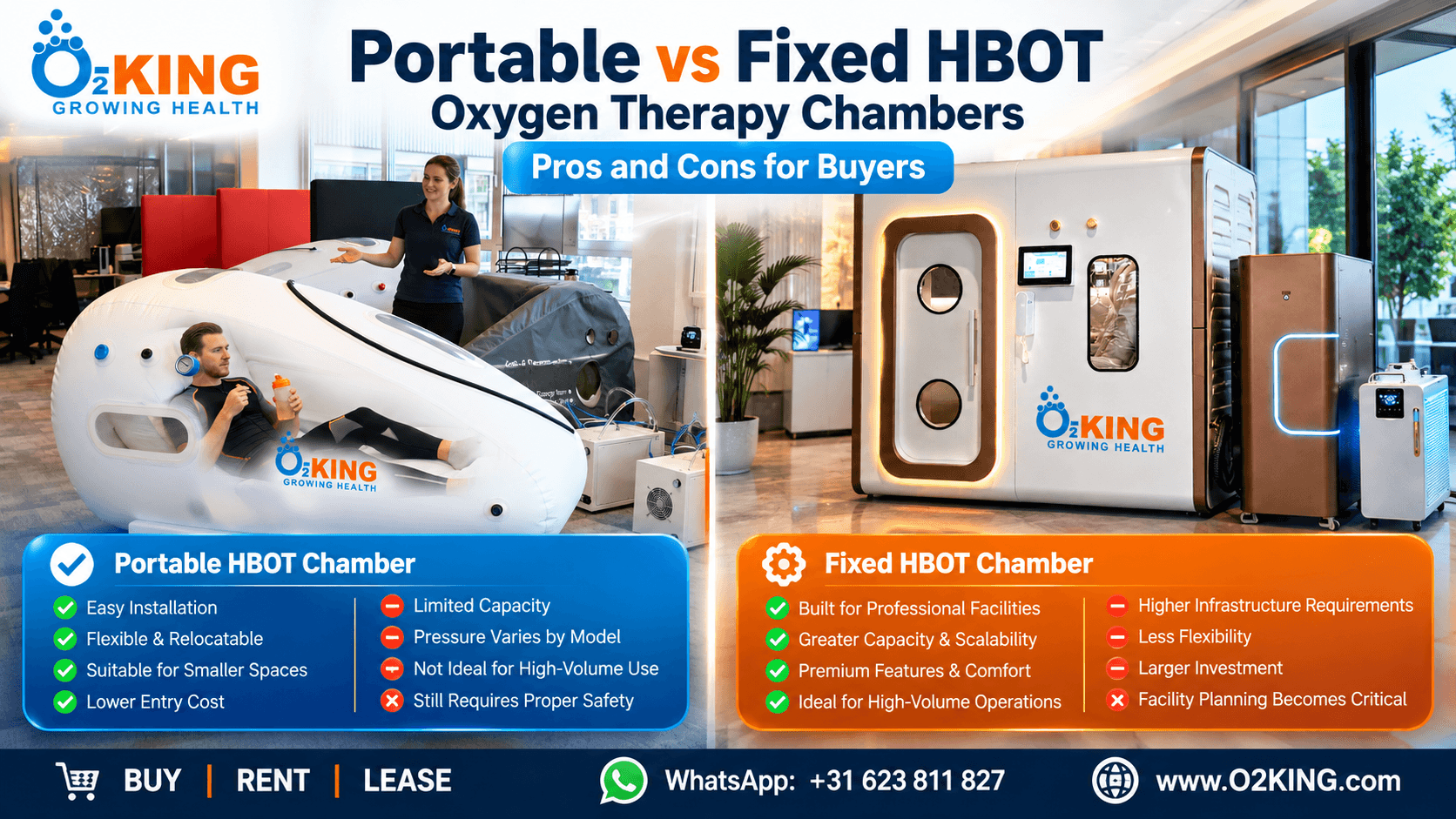
Choosing a hyperbaric oxygen therapy chamber is not simply a matter of deciding which model looks better or has the highest pressure rating. For a buyer, it is a practical investment decision involving space, budget, safety, intended use, staffing, patient capacity, installation requirements, and long-term business plans.
That is why the portable HBOT oxygen therapy chamber has become an interesting option for homes, personal recovery environments, mobile wellness concepts, sports facilities, and smaller businesses, while fixed hyperbaric systems continue to make sense for clinics, professional recovery centers, longevity facilities, and high-volume operations.
The right choice depends less on the word “portable” or “fixed” and more on what you actually want the chamber to do.
This fixed hyperbaric chamber comparison explains the major differences, the advantages and limitations of each approach, and the questions buyers should ask before committing to an investment.
What Is the Difference Between a Portable and a Fixed HBOT Chamber?
At the most basic level, a portable chamber is designed around flexibility. It can generally be installed with less permanent infrastructure and, depending on its design, can be relocated more easily than a permanently installed system.
A fixed chamber, by contrast, is intended to become part of a facility. It may require dedicated floor space, more extensive electrical or mechanical planning, installation work, staff training, and a defined operating environment.
However, there is an important distinction buyers should understand: portable versus fixed is not the same thing as soft versus hard, or mild versus higher-pressure.
There are different chamber architectures, and specifications vary considerably from one manufacturer and model to another. Clinical hyperbaric practice also distinguishes between monoplace and multiplace chambers. UHMS describes monoplace chambers as systems intended for one patient at a time, while multiplace chambers are designed to accommodate multiple occupants in a pressurized air environment while oxygen is delivered through a breathing system.
In other words, buyers should evaluate the complete system rather than relying on one label.
Portable HBOT Oxygen Therapy Chamber: The Pros
1. Easier Installation
One of the biggest attractions of a portable system is the relatively simple approach to installation.
A permanently installed hyperbaric facility may require careful planning of the room, utilities, ventilation, electrical systems, fire-safety arrangements, access, operator controls, and maintenance procedures. Portable systems can often simplify the physical setup, although buyers must still follow the manufacturer’s installation requirements and applicable local regulations.
For a private user or small wellness business, reducing infrastructure complexity can make a significant difference.
Instead of designing an entire room around the chamber, the chamber can potentially become one component of an existing wellness or recovery environment.
2. Greater Flexibility
Space requirements can change.
A gym might move equipment. A sports-recovery business might relocate. A wellness center could expand into a larger premises. Even a homeowner may eventually redesign a room.
Portability provides an element of flexibility that a permanently installed system cannot easily match.
This can be especially attractive for businesses testing the market before committing to a large dedicated facility.
3. Suitable for Smaller Spaces
Not every buyer has a large clinical facility.
Personal recovery rooms, boutique wellness studios, private gyms, physiotherapy environments, hotels, and smaller performance centers may have limited floor space.
A compact chamber can make it possible to introduce hyperbaric equipment without sacrificing an entire room or redesigning a building.
4. Potentially Lower Entry Barrier
Depending on the chamber’s construction, pressure capability, accessories, and supporting equipment, a portable system may offer a lower initial investment than a large permanently installed hyperbaric facility.
But buyers should be careful here.
The cheapest chamber is not necessarily the least expensive chamber to own.
A proper comparison should include equipment price, oxygen supply, compressor requirements, installation, shipping, maintenance, training, consumables, warranty coverage, servicing, and expected utilization.
A low purchase price can become less attractive if after-sales service or spare parts are difficult to obtain.
Portable HBOT Chambers: The Cons
1. Portability Does Not Eliminate Safety Requirements
“Portable” should never be interpreted as “simple enough to use without proper procedures.”
HBOT involves pressurization and, depending on the system and treatment environment, oxygen-enriched conditions. The FDA issued a safety communication in August 2025 reminding healthcare providers and facilities to follow the manufacturer’s instructions, maintain fire-prevention measures, provide proper staff training, monitor users throughout treatment, and follow prescribed cleaning and maintenance procedures.
UHMS similarly emphasizes that hyperbaric chamber safety depends on pressure-vessel engineering, fire-safety engineering, and appropriate operating practices.
A portable chamber therefore still deserves professional handling.
2. Capacity Can Be Limited
Many portable designs are intended for one user.
That may be perfectly adequate for a home user or a personal recovery studio, but it becomes a limitation when a business expects multiple clients or athletes every day.
Imagine a sports recovery center with twelve athletes arriving after training. A single-seat chamber can serve them, but throughput becomes a scheduling issue.
A larger fixed or multiplace system can fundamentally change the economics of the operation.
3. Pressure Capability Varies
One of the biggest mistakes buyers make is comparing chambers solely by their appearance or price.
Pressure capability matters, but higher pressure is not automatically “better” for every application.
Treatment pressure and oxygen delivery should be matched to the intended use, the specific equipment, applicable regulations, and qualified professional protocols.
Some portable systems are designed for mild-pressure applications, while other portable or semi-portable systems can have substantially different specifications. Buyers should therefore compare the manufacturer’s documented operating pressure rather than assuming that every portable chamber works in the same way.
4. Less Suitable for High-Volume Operations
A chamber that works beautifully for one private user can become inefficient in a busy commercial facility.
If the business model depends on frequent daily sessions, the owner needs to consider:
How many users can be accommodated?
How long does each session take?
How much time is required between users?
How much staff involvement is needed?
What happens when maintenance is required?
These questions matter more than the word “portable” on a brochure.
Fixed Hyperbaric Chamber: The Pros
1. Built for a Dedicated Environment
A fixed hyperbaric chamber becomes part of the facility rather than simply sitting inside it.
This can create a more structured operating environment.
A dedicated room can be designed around the chamber, control equipment, patient preparation, staff workflow, monitoring, ventilation, cleaning, storage, and emergency procedures.
For a professional HBOT center, that permanence can be a major advantage.
2. Greater Scalability
Fixed systems can provide a broader range of configurations.
Depending on the manufacturer’s product range, buyers may choose single-user systems, larger hard chambers, sitting or lying configurations, or multiplace systems.
UHMS guidance distinguishes monoplace and multiplace clinical chambers, with multiplace chambers supporting more than one occupant under pressure and using oxygen-delivery systems such as masks or hoods.
For a commercial facility, that difference can directly affect throughput.
A business serving a handful of customers each week has different requirements from a center serving dozens of clients every day.
3. More Room for Premium Features
A larger permanent installation can provide opportunities for features that may be difficult to incorporate into a compact portable system.
Depending on the model, this may include more spacious interiors, reclining or lying configurations, integrated monitoring, larger viewing areas, advanced oxygen-delivery equipment, additional control systems, or specialized facility integration.
For luxury longevity centers and high-end recovery facilities, the physical experience matters as well as the technical specification.
The chamber becomes part of the customer journey.
4. Stronger Fit for Professional Facilities
A permanently installed chamber can be a natural fit for a medical or wellness facility where HBOT is a core service rather than an occasional add-on.
For such buyers, the chamber may need to operate alongside:
- trained operators,
- treatment protocols,
- documentation systems,
- maintenance schedules,
- patient or client workflows,
- emergency procedures,
- regulatory requirements,
- cleaning and infection-control processes.
The chamber is no longer simply equipment. It becomes part of an operational system.
Fixed Hyperbaric Chamber: The Cons
1. Higher Infrastructure Requirements
A fixed installation may require more planning before the first session can take place.
Depending on the system and jurisdiction, this can involve building modifications, electrical work, ventilation, fire-safety planning, equipment placement, access routes, staff areas, and commissioning.
This is why the purchase price should never be viewed in isolation.
The total project cost matters.
2. Less Flexibility
Once a large chamber is installed, moving it is not comparable to moving a piece of gym equipment.
Relocation may require professional engineering, disassembly, transportation, reinstallation, and renewed inspection or commissioning.
For a business expecting to move premises within a few years, this can be an important consideration.
3. Larger Capital Commitment
A fixed system can involve a substantially greater investment, particularly when the project includes facility construction, high-capacity oxygen systems, monitoring equipment, professional installation, and staff preparation.
This can be justified when utilization is high, but it may not make financial sense for a buyer who expects limited usage.
4. Facility Planning Becomes Critical
With a fixed system, the room becomes part of the investment.
Poor planning can create problems with workflow, accessibility, maintenance access, patient privacy, staff movement, or future expansion.
A chamber should therefore be considered during the facility-design stage rather than being treated as an afterthought.

Portable vs Fixed HBOT: Side-by-Side Comparison
| Factor | Portable HBOT Chamber | Fixed Hyperbaric Chamber |
|---|---|---|
| Installation | Generally simpler and more flexible | Requires dedicated planning |
| Relocation | Easier, depending on model | More complex |
| Space requirement | Typically lower | Typically higher |
| Initial investment | Can be lower depending on specification | Often higher |
| User capacity | Often single-user | Single-user or multiplace, depending on model |
| Commercial throughput | Better for lower-volume use | Better suited to higher-volume operations |
| Facility integration | Limited to moderate | High |
| Expansion potential | Depends strongly on model | Generally greater |
| Premium interior space | Usually more limited | Can be significantly greater |
| Dedicated room | Not always necessary | Commonly required |
| Best fit | Home, small studio, mobile/flexible environments | Clinics, recovery centers, longevity facilities, larger operations |
| Mobility | Major advantage | Major limitation |
| Infrastructure | Lower complexity in many setups | Greater complexity |
| Long-term scalability | Model-dependent | Generally stronger |
The table is a starting point, not a universal rule. A sophisticated portable hard chamber can have very different characteristics from a compact soft chamber, while a small fixed monoplace system can have very different operational requirements from a large multiplace installation.
The Most Important Question: What Are You Building?
Before buying an HBOT chamber, ask yourself what the business or personal setup is supposed to become.
Are you purchasing a chamber for occasional personal use?
Are you adding HBOT to an existing gym?
Are you opening a recovery studio?
Are you building a premium longevity center?
Are you developing a biohacking facility?
Are you creating a medical environment with professional clinical services?
These are completely different projects.
A person purchasing one chamber for personal use should not necessarily be shopping with the same criteria as an entrepreneur developing a six-figure recovery business.
Portable vs Fixed: Which One Makes Sense for a Longevity Center?
A longevity center is typically more than a room containing one piece of equipment.
The concept often revolves around creating an integrated customer experience involving recovery, wellness, diagnostics, performance, lifestyle services, and other technologies.
In that environment, the chamber must fit into the overall operating model.
A portable chamber may be attractive when the business is beginning with one treatment room and wants flexibility.
A fixed system may become more compelling when the center expects consistent demand, premium positioning, multiple daily sessions, and future expansion.
The crucial point is to buy according to the business model, not simply today’s budget.
What About a Biohacking Hyperbaric Setup?
The biohacking market places strong emphasis on personalization, recovery, performance, longevity, and technology.
That makes chamber selection particularly interesting.
A private biohacking room may prioritize comfort, aesthetics, ease of use, low space requirements, and convenience.
A professional biohacking facility may instead prioritize durability, throughput, advanced controls, premium construction, and integration with a broader longevity ecosystem.
The best equipment on paper can still be the wrong equipment for the room.
A beautifully engineered large chamber is not automatically the right choice for a small private studio. Likewise, a compact portable unit may become a bottleneck inside a busy professional facility.
Pressure Is Important—but It Is Not the Whole Story
Many buyers begin their research by asking one question:
“How many ATA does the chamber reach?”
It is an understandable question, but it should not be the only question.
Pressure is one technical parameter among many.
A responsible buying process should examine chamber construction, pressure rating, oxygen-delivery method, compressor and concentrator specifications, monitoring systems, emergency procedures, maintenance requirements, manufacturer documentation, installation requirements, operator training, and applicable standards or regulations.
ASME’s PVHO-1 standard, for example, addresses the design, fabrication, inspection, testing, marking, and certification of pressure vessels for human occupancy, including hyperbaric chambers, within its scope.
The important takeaway is simple: buy the complete safety and operating system, not just the headline ATA number.
Don’t Overlook Oxygen Supply
Another important difference between chamber systems is how oxygen is supplied.
Depending on chamber design, oxygen may be supplied through a dedicated breathing system, oxygen concentrator, or other configuration.
The oxygen source needs to be compatible with the chamber and its intended operating conditions.
The FDA specifically emphasizes following the manufacturer’s instructions for use, including safety requirements related to oxygen, equipment, grounding, prohibited items, clothing, cleaning, and maintenance.
When comparing products, buyers should therefore ask:
What oxygen concentration is delivered?
What equipment generates or supplies the oxygen?
What happens if the oxygen supply is interrupted?
What maintenance does the oxygen system require?
What are the manufacturer’s documented operating procedures?
These questions can reveal more about a chamber’s real-world suitability than marketing language.
Safety Should Be Part of the Buying Decision
Hyperbaric chambers are specialized pressure systems. Oxygen-rich environments also require careful fire-safety management.
That makes safety engineering one of the most important purchasing criteria.
The FDA’s 2025 communication highlighted reports of serious injuries and deaths associated with HBOT devices and stressed fire prevention, training, supervision, grounding, manufacturer instructions, and scheduled maintenance.
UHMS likewise identifies pressure-vessel engineering, fire safety, and operating practices as fundamental components of safe hyperbaric chamber operation.
A serious buyer should therefore ask a manufacturer for documentation rather than accepting vague phrases such as “medical-grade,” “professional,” or “international standard” without supporting information.
Questions Buyers Should Ask Before Purchasing
Before signing an order, ask the manufacturer to provide clear answers to the following:
What is the exact operating pressure?
Do not rely on a product family description. Ask for the specification of the exact model being purchased.
Is the chamber portable, relocatable, or permanently installed?
“Portable” can mean different things in different product categories.
How many users can it accommodate?
Single-user, dual-user, and multiplace systems have very different operating economics.
What oxygen system is included?
Ask whether the chamber comes with an oxygen concentrator, breathing system, compressor, filtration, cooling system, or other required components.
What training is included?
Staff competence matters. The FDA explicitly emphasizes appropriate training and supervision.
What maintenance is required?
Ask about service intervals, replacement parts, calibration, cleaning, inspections, and technical support.
What happens if the chamber develops a fault?
A chamber that is out of service is not producing revenue for a commercial facility.
What documentation is provided?
Ask for manuals, technical specifications, safety documentation, certificates, testing records, and installation requirements applicable to the specific model and destination market.
What are the local regulatory requirements?
Regulation differs between countries and jurisdictions. A chamber suitable for one market may require additional approvals, documentation, installation requirements, or professional oversight elsewhere.
Buy, Rent, or Lease?
The financing model deserves just as much attention as the chamber itself.
Buying
Buying can make sense for organizations that expect long-term, consistent utilization.
The equipment becomes a capital asset, and the owner has maximum control over the operating model.
Renting
Rental can reduce the initial commitment and can be useful when a business wants to test demand before making a larger investment.
For a new wellness or recovery concept, this can provide valuable real-world information.
Leasing
Leasing can spread the financial commitment over time and may make a more advanced chamber accessible without the full upfront purchase price.
For business owners, the decision should be evaluated using utilization, expected revenue, financing cost, maintenance, depreciation, and long-term ownership plans—not merely the monthly payment.
O2-KING HBOT Chambers for Longevity Centers and Biohacking Setups
For buyers researching an HBOT oxygen therapy chamber for a longevity center or a biohacking hyperbaric setup, O2-KING offers chamber solutions for private and professional environments, with options covering different configurations and business requirements. O2-KING states on its current website that it is a member of the International Hyperbaric Association (IHA) and the International Board of Undersea Medicine (IBUM), and states that it is IHA & IBUM certified. The organizations themselves describe IHA as an educational and membership organization supporting the responsible use of hyperbaric therapy, while IBUM provides education, credentials, and facility-related certification programs in the hyperbaric field. For a buyer looking for a premium hyperbaric setup for a longevity center, wellness facility, sports recovery business, or biohacking environment, O2-KING positions its product range as a high-end solution, with BUY, RENT, and LEASE options and support covering delivery, installation, training, and technical service.
Why the Fixed Hyperbaric Chamber Comparison Matters
When people compare portable and fixed systems, it is tempting to ask:
“Which one is better?”
That question is too broad.
A better question is:
“Which one is better suited to my intended use?”
For one person, portability may be the decisive advantage.
For another, it may be completely irrelevant.
A small recovery studio might value flexibility and lower infrastructure requirements. A high-volume longevity center might care much more about throughput, durability, staff workflow, room design, and future expansion.
Think of it like choosing a vehicle.
A compact car may be perfect for one driver commuting through a city. A commercial operator moving heavy equipment has a completely different requirement.
The “best” vehicle depends on the job.
The same logic applies to HBOT chambers.
A Practical Decision Framework for Buyers
A useful way to approach your purchase is to score your priorities before speaking with manufacturers.
Choose portability when your priorities are:
Flexibility, smaller space requirements, personal use, lower-volume operation, easier relocation, or testing an HBOT concept before making a larger facility investment.
Consider a fixed system when your priorities are:
High utilization, professional facility integration, larger interiors, greater throughput, premium customer experience, long-term scalability, or a dedicated HBOT business.
Consider a larger multiplace system when your priorities are:
Multiple occupants, higher operational capacity, professional clinical environments, and a business model that supports the infrastructure required for a larger hyperbaric facility.
The goal is not to buy the most complicated chamber.
The goal is to buy the chamber that fits the job.
Final Thoughts
The portable-versus-fixed debate is really a question about strategy.
A portable HBOT oxygen therapy chamber can provide flexibility, easier deployment, and an accessible route into hyperbaric wellness or recovery for certain buyers.
A fixed hyperbaric chamber can provide permanence, scalability, facility integration, and greater capacity for organizations building a dedicated professional operation.
Neither category should be judged solely by price, size, appearance, or pressure rating.
Look at the complete picture: safety, specifications, oxygen delivery, construction, installation, training, maintenance, capacity, local requirements, after-sales support, and expected utilization.
For an individual buyer, the decision may come down to convenience and available space.
For a business owner, it is ultimately an investment decision.
And for a longevity center or biohacking facility, the chamber should be viewed as part of the larger ecosystem—not as an isolated machine.
O2-KING provides HBOT oxygen chamber solutions with BUY, RENT, and LEASE options for private and professional environments. O2-KING’s current website identifies the company as an IHA and IBUM member and states that it is IHA & IBUM certified.
To discuss your requirements, chamber configuration, installation, or commercial setup:
O2-KING — Growing Health
Visit the official O2-KING website: www.O2KING.com
Important: HBOT equipment is specialized pressure equipment. Product selection, installation, operation, and treatment protocols should follow the manufacturer’s instructions and all applicable local laws, standards, and professional requirements. Individual treatment suitability should be determined with an appropriately qualified healthcare professional where medical treatment is involved.
